The Newsletter Personalization Gap: Why Your Subscribers Trust Your Words But Skip Your Ads
 Eren DaskesenFebruary 27, 2026Updated March 2, 202615 min read
You wrote 847 words this morning. You agonized over the opening line. You cut two paragraphs that didn't earn their place. You re-read the whole thing out loud to make sure it sounded like you.
Then you pasted in a sponsor block that sounds like it was written by a completely different person. Because it was. And you have to publish it. Sad, isn't it?
Your readers noticed. Not consciously, their brains registered the shift before they processed a single word of that ad. Eye tracking research spanning three decades from Nielsen Norman Group shows that readers develop a neurological skip pattern for content that doesn't match the surrounding editorial voice. The pattern fires in under a second. It's automatic. And it's costing you money every single time you hit send.
The most expensive sentence in your newsletter isn't the one you spent the most time writing. It's the sponsor copy you didn't write at all.
This is the newsletter personalization gap and in 2026, it's the single most important trend operators need to understand. Not because personalization is new, but because what it means is changing.
What Are the Biggest Newsletter Trends in 2026?
If you've read any "newsletter trends" roundup this year, you've seen the usual suspects: AI assisted content creation, interactive elements, hyper segmented audiences, paid subscription growth. Those trends are real. But they're also table stakes.
The newsletter industry is in the middle of an extraordinary expansion. beehiiv's 2026 State of Newsletters report documents 28 billion emails sent across their platform in 2025, reaching over 255 million unique readers, with open rates holding above 41% despite increasing inbox competition. Paid subscriptions generated $19 million in 2025, a 138% jump from $8 million the year before. The median time from launching a newsletter to earning your first dollar dropped to just 66 days.
At the same time, the broader creator economy is accelerating around newsletters as a core business model. Digiday reports that U.S. creator economy ad spend will reach $43.9 billion in 2026, up from $37.1 billion in 2025, with paid amplification of direct creator partnerships increasing by 48–56%.
Newsletters sit at the center of this growth because they solve the problem every other platform has made worse: trust. The Reuters Institute's 2025 Digital News Report found that trust in traditional news media remains stuck at 40% globally, with 40% of audiences actively avoiding news up from 29% in 2017. Meanwhile, newsletters built on a single writer's voice and perspective are thriving precisely because subscribers chose to be there.
But here's the trend that none of the roundups are covering: the biggest monetization bottleneck in newsletters isn't audience size, open rates, or even sponsor pricing. It's the voice mismatch between the content readers subscribed for and the ads they're being served.
The Voice Mismatch Problem: What "Personalization" Has Been Missing
When the newsletter industry talks about personalization, it almost always means one thing: segmentation. Send different content to different reader cohorts based on their behavior, preferences, or demographics.
That matters. INMA's research on premium newsletters shows that personalized newsletter content can improve subscriber retention by up to 58%, with open rates reaching 74% and click rates hitting 25% for the best performing personalized content. Each 1% improvement in retention adds an estimated $2 to 4 in customer lifetime value per subscriber.
But that research describes editorial personalization, tailoring what content readers see. Almost nobody is talking about how that content sounds when it reaches the sponsor block.
This is a significant blind spot. You might segment your audience into three cohorts, personalize subject lines, and dynamically insert content blocks based on reader behavior. Well done, all sophisticated moves. But if every cohort receives the same generic sponsor copy written by an advertiser's marketing team, all that personalization effort stops at the revenue line.
Shocker? Not exactly. It's science, at its finest.
Think about what happens when a subscriber reads your newsletter. They're engaged with your voice: your sentence rhythms, your vocabulary choices, your particular way of building an argument or landing a joke. Their brain has settled into a processing pattern tuned to YOU. Cognitive scientists call this state "processing fluency," and research published in Frontiers in Psychology demonstrates that it directly mediates consumer attitudes toward advertising. When processing is easy, trust follows. When it's disrupted, skepticism kicks in.
Surprised? Don't be. It's science, plain and simple.
Then the sponsor block arrives. Different sentence structure. Different vocabulary density. Different emotional register. The reader's brain operating in what Nobel winner Daniel Kahneman describes as System 1 mode in his legendary book Thinking, Fast and Slow, the fast, automatic processing that governs most daily decisions, flags the shift instantly. Not as "this is an ad" in conscious language, but as a felt sense that something changed. The fluency broke. The reading experience stuttered.
In English: The revenue is gone.
Banner blindness isn't a design problem. It's a voice problem. And you, as a newsletter operator is the last person who should be surprised by this, because voice is the entire reason your audience exists.
How Does Banner Blindness Actually Work in Newsletters?
The mechanics are more specific than most operators realize, and the research is older and more robust than the newsletter industry tends to acknowledge.
Nielsen Norman Group has documented banner blindness across three decades of eye tracking studies starting from their foundational 1997 research through their most recent findings. Users fixate on areas that look like ads less than 1% of the time, regardless of whether those areas contain relevant information. Their studies identified what they call "hot potato" scanning: readers' eyes land on ad adjacent content and immediately bounce away, as if the area were too hot to touch.
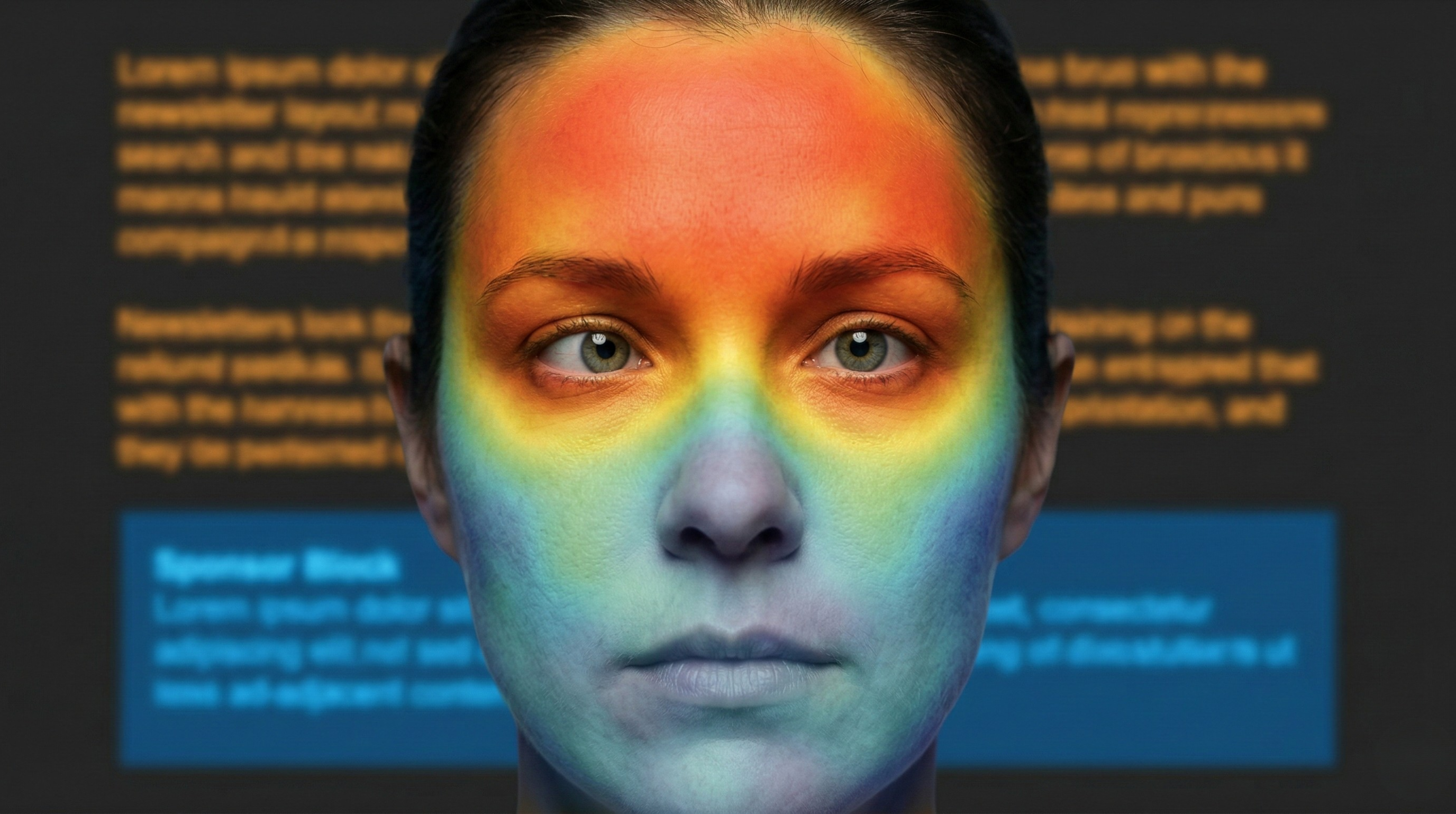
In Blindsight, Matt Johnson and Prince Ghuman explain the underlying mechanism: our brains process marketing stimuli through dual channels: a conscious evaluation pathway and a much faster subconscious pattern matching system. When content shifts voice, the subconscious system flags it as "not from the person I'm listening to" before the conscious mind has finished reading the first sentence.
Martin Lindstrom's large scale neuromarketing research in Buyology reinforces this from the brand perception side. His work demonstrates that brand inconsistent messaging triggers measurable neural de-prioritization. The brain doesn't just passively skip mismatched content; it actively redirects processing resources elsewhere. It's like your reader's way of saying "I'll look somewhere else until you start speaking to me in your voice again." Why not? After all, they subscribed to your newsletter for your voice in the first place.
For newsletter operators, this creates a specific, measurable problem. The sponsor block you're running isn't just underperforming because the copy could be sharper. It's underperforming because your reader's brain detected a voice mismatch and disengaged before conscious evaluation even began.
This is worth sitting with for a moment. You might have the most relevant sponsor in your niche. The offer might be genuinely useful to your audience. The copy might be well written by any normal standard. But if it doesn't sound like you, your reader's subconscious has already moved on before their conscious mind gets a chance to evaluate the offer on its merits.
The numbers reflect this. Native ads, content formatted to match the surrounding editorial environment, achieve average click-through rates of 0.30%, compared to 0.12% for standard display banners. That's a 2.5x performance gap. Native ads also receive 53% more visual attention, increase purchase intent by 18%, and see sharing rates of 32% versus 19% for display. These advantages don't come from better targeting or smarter creative strategy alone. They come from reduced cognitive friction, from matching the voice.
Is Newsletter Advertising Still Effective?
This is one of the most common questions in the space, and the answer is more nuanced than either the optimists or the skeptics suggest.
Newsletter advertising as a channel is growing rapidly. A Morning Brew survey of marketing decision makers found that 51% named email marketing as an investment priority for 2025.
The underlying economics favor newsletters heavily. Litmus's email marketing ROI research consistently shows that email returns an average of $36 for every $1 spent: a 3,600% ROI that outperforms every other marketing channel. And here's the critical detail that most operators miss: brands that use personalization "often or always" in their email programs achieve an ROI of 43:1, compared to just 12:1 for brands that rarely or never personalize. That's roughly a 260% increase in returns from personalization alone.
But those numbers describe the channel's potential. Individual newsletter operators often see a different reality: sponsor CTRs that plateau, advertisers who don't renew, and a nagging sense that ads are eroding the reader trust that makes everything else work.
The gap between newsletter advertising's potential and most operators' reality is the voice mismatch. The channel is strong. The first party relationship is valuable. But when the ad copy breaks the voice contract between writer and reader, that value leaks.
Why 2026 Is the Inflection Point for Voice Matched Personalization
Three converging forces make 2026 the year voice personalization moves from "interesting idea" to "operational necessity."
Force 1: The First Party Data Premium
Google's Privacy Sandbox initiative is officially dead. After six years of development, Google confirmed in October 2025 that it was retiring the entire project. Third party cookies remain technically available in Chrome, but their effectiveness continues to erode as users increasingly block, delete, or reject them.
This makes newsletter subscriber relationships (direct, permission based, first party data connections) dramatically more valuable to advertisers. The newsletter inbox is one of the last remaining environments where brands can reach an engaged, opted in audience without algorithmic mediation. Advertisers know this.
For newsletter operators, this privacy shift is both an opportunity and a pressure test. Advertiser budgets are moving toward newsletters because the targeting is inherently privacy compliant. You're reaching people who opted in, not tracking them across the web. But that premium positioning raises the performance bar. Brands paying $25 to 50 CPM for newsletter placements are increasingly scrutinizing click-through rates and conversion data. Generic sponsor copy that would have been acceptable in a $10 CPM environment looks like wasted budget at $40 CPM.
Force 2: Subscriber Expectations Have Shifted
The global creator economy reached approximately $200 billion in 2025 and is growing at a 22.7% CAGR. Within this landscape, newsletters have emerged as the preferred content format for creators with 58% of creators choosing newsletters as their primary content type and 27% of creators reporting that newsletters drive their best audience engagement.
This growth means readers now have more newsletter options than ever. They're choosing carefully, and they're choosing based on voice. Subscribers who detect a voice inconsistency (even subconsciously through a jarring sponsor block) have lower switching costs than at any point in the medium's history. Sorry folks. This is the truth.
Force 3: The Trust Premium Is Measurable
Trust isn't abstract anymore. It's a retention metric.
INMA's data shows that retention rates run 40% higher for subscribers receiving personalized, premium newsletter content. Subscriber only newsletters achieve a 66% average open rate and 13% average CTR, numbers that dwarf industry averages.
But "personalized" in INMA's data doesn't just mean segmented. It also means consistent. The newsletters with the highest retention are the ones where every element such as editorial, curation, and yes, sponsor content feels like it comes from the same trusted source. When your sponsor block breaks that consistency, you're not just losing a click. You're introducing friction into the trust relationship that drives every other metric in your business. You're somewhat betraying the trust of your reader.
How Do I Improve Newsletter Ad Click-Through Rates?
This is where the trend translates into action. And the good news is that voice matched personalization isn't an all or nothing proposition. You can start improving today.
The Voice Audit: A 15 Minute Exercise
Before investing in any tool or process, run this diagnostic on your own newsletter:
Pull your last 5 newsletters that included sponsor content.
Read each one out loud: editorial and sponsor copy, in sequence, without pausing between them.
Mark the moment where you can hear the voice shift. If you're reading naturally, you'll feel your cadence change, your vocabulary shift, your emotional register adjust. That's the mismatch point.
Count the linguistic signals: Does the sponsor copy use different sentence lengths? More adjectives per sentence? Different punctuation patterns? More imperative verbs ("Get," "Try," "Discover") than your editorial style?
Rate the gap on a 1 to 10 scale: where 10 = "sounds like I wrote it" and 1 = "sounds like a different publication." Most operators land between 3 and 5.
This exercise costs nothing and reveals the exact size of your voice gap. It also gives you a baseline to measure improvement against.
The Rewrite Test: Quantify the Impact
Pick your highest value sponsor. You know, the one with the most sends remaining on their contract. Rewrite one ad placement in your own voice. Keep the same offer, the same CTA, the same value proposition. Change only the way it's expressed. match your sentence rhythms, your vocabulary level, your characteristic turns of phrase.
Run the rewritten version for 2 to 4 sends. Compare CTR against the previous placements with the original copy. Even a rough A/B comparison will show you the revenue sitting on the table.
The Systematic Approach
For operators running multiple sponsors per month, rewriting every ad manually doesn't scale. This is the problem that voice matching tools like AdApt were built to solve: analyzing the linguistic patterns in your editorial content and applying them to sponsor copy so every ad sounds like you wrote it. The process takes seconds rather than hours, and it preserves the cognitive fluency your readers expect.
But whether you use a tool or do it yourself, the principle is the same: every element of your newsletter should sound like it comes from the same voice your readers subscribed to hear.
How Does AI Help With Newsletter Personalization?
The AI conversation in newsletters has mostly focused on content generation, such as using language models to draft editorial copy, generate subject lines, or create audience segments. Those applications matter, but they miss the highest leverage application of AI in newsletter monetization.
The real opportunity is using AI not to replace your voice, but to extend it. Specifically, to analyze the linguistic fingerprint of your writing: sentence structure, vocabulary density, emotional register, punctuation patterns, paragraph rhythm, and apply that fingerprint to sponsor copy that arrives in a completely different voice.
This is distinct from asking ChatGPT or another general purpose AI to "rewrite this ad in a casual tone." General purpose models don't learn your specific voice. They approximate a generic register. This is why nothing change when you tried doing this. Don't worry though, you're not alone. The result often falls into what readers instinctively recognize as "AI copy", technically competent but missing the specific personality that makes your newsletter yours.
Voice matching AI, by contrast, treats your published writing as training data for a style model. It doesn't generate your ideas or replace your editorial judgment. It takes existing sponsor copy and translates it into your linguistic patterns, the same way a skilled editor might rewrite a press release to match a publication's house style, but in seconds rather than hours.
The distinction matters because the Knak email marketing trends report for 2026 specifically flagged "AI slop". Generic, obviously automated content as a growing subscriber concern. Readers are developing sensitivity to AI generated text the same way they developed banner blindness. The solution isn't less AI. It's AI that's invisible because it matches the human voice readers already trust.
What to do?
Newsletter personalization in 2026 means voice consistency, not just audience segmentation. The biggest gap in most operators' monetization isn't who sees the ad, it's how it sounds when they do and how they behave when they do.
Banner blindness in newsletters is driven by voice mismatch, not design. Three decades of eye tracking research and cognitive fluency studies confirm that readers disengage from content that breaks the processing pattern established by surrounding editorial copy.
The economics are converging. The death of Google's Privacy Sandbox, rising creator economy ad spend and subscriber expectations shaped by a 138% increase in paid newsletter subscriptions all point toward newsletters that treat voice consistency as a monetization lever.
You can audit your voice gap in 15 minutes. Read your editorial and sponsor copy out loud, back to back. The moment you hear the shift is the moment your readers' brains disengage. No tool required. Just use your voice and honest ears. In the end, what do you have to trust more?
Personalization driven email programs achieve 260% higher ROI (43:1 vs 12:1, per Litmus data). When you extend that personalization from editorial to sponsor content, you're applying proven economics to the single most under optimized element of your newsletter. (Did I said "science?")
Your subscribers chose your newsletter because they trust your voice. They open it because they expect you. Every element that breaks that expectation, even a well written sponsor ad in someone else's voice is a small withdrawal from a trust account that took you months to build.
Remember those 847 words you wrote this morning? You know exactly why you agonized over them. You know the difference between a sentence that sounds like you and one that just sounds competent. Your readers know that difference too, even if they couldn't articulate it. So, in the future, the newsletters that thrive won't just personalize what they send. They'll personalize how everything sounds. Because in a world where trust is the scarcest resource and attention is the most contested, voice isn't a style choice. It's your competitive moat.